Sunday, 6 April 2014

William Eggleston

As whole I am not moved by the work of William Eggleston. It is images like the one below that makes me wonder what the world has come to, if this is the work of one of the most esteemed artist in history. The image can only be describe as ugly.

As much as I understand that much of Eggleston's work was to photograph the ugly as stated in the this documentary https://www.youtube.com/watch?v=UVm8S7mB23o is this ugly for ugly's sake that I find completely forgettable about his work.


However this is not to say that Eggleston's work should be completely overlooked. Eggleston's work has also been described as finding beauty in the banal https://www.youtube.com/watch?v=gGR6_H-G17c and this is where I feel Eggleston occasionally hits the nail on the head. Such as in the two images below where he has used different perspectives to create interest in his images.


Eggleston's work has also been described of well considered in composition https://www.youtube.com/watch?v=UVm8S7mB23o and as shown above this is true for some of his images. But I find that majority of his images are like those below. Taken straight with little interest.


Pop Art

Explain Pop Art’s relationship to the 
dada movement.
“Pop Art is a direct descendant of Dadaism. They mock the established art world by appropriating images from the street, the supermarket, the mass media, and presents it as art in itself.” http://www.artmovements.co.uk/popart.htm

How did the American take on Pop Art 
differ from that of the UK?
British pop art evolved from the Dada movement and took on the idea of creating random and absurd images to mock convention and bring art to the everyday people. Where as American pop art was a reaction against obscure in Abstract and Expressionist images and makes art more relevant to the real world.

How has the visual aesthetic of Pop 
Art  influenced contemporary artists/ 
photographers?
I think that some iconic images of pop art have themselves been popularised and therefore been subverted themselves, and the colours used in other 60's fashion.


How has the “subversive” movement of
 Pop Art influenced contemporary art/ 
photography?
 
I think that the subversive are movement has used art as a voice an artist to comment on society.

Tuesday, 1 April 2014

My attempt at Post Modernism


Photographer Belinda Vecchio
Influenced by Post Modernism


The image above is based on the Vitruvian Man by Davinic. It shows the idea that over the years man has not changed however we are far less comfortable with the naked form.

Wednesday, 26 March 2014

Post modernism

Postmodernism

A general and wide-ranging term which is applied to literature, art, philosophy, architecture, fiction, and cultural and literary criticism, among others. Postmodernism is largely a reaction to the assumed certainty of scientific, or objective, efforts to explain reality. In essence, it stems from a recognition that reality is not simply mirrored in human understanding of it, but rather, is constructed as the mind tries to understand its own particular and personal reality. For this reason, postmodernism is highly skeptical of explanations which claim to be valid for all groups, cultures, traditions, or races, and instead focuses on the relative truths of each person. In the postmodern understanding, interpretation is everything; reality only comes into being through our interpretations of what the world means to us individually. Postmodernism relies on concrete experience over abstract principles, knowing always that the outcome of one's own experience will necessarily be fallible and relative, rather than certain and universal.
Postmodernism is "post" because it is denies the existence of any ultimate principles, and it lacks the optimism of there being a scientific, philosophical, or religious truth which will explain everything for everybody - a characterisitic of the so-called "modern" mind. The paradox of the postmodern position is that, in placing all principles under the scrutiny of its skepticism, it must realize that even its own principles are not beyond questioning. As the philospher Richard Tarnas states, postmodernism "cannot on its own principles ultimately justify itself any more than can the various metaphysical overviews against which the postmodern mind has defined itself."

http://www.pbs.org/faithandreason/gengloss/postm-body.html

Pop Art

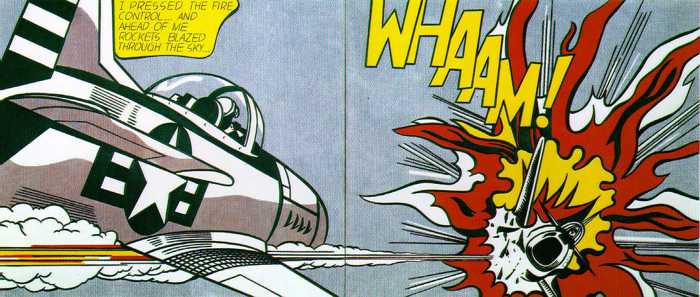
Pop Art was the art of popular culture. It was the visual art movement that characterised a sense of optimism during the post war consumer boom of the 1950's and 1960's. It coincided with the globalization of pop music and youth culture, personified by Elvis and the Beatles. Pop Art was brash, young and fun and hostile to the artistic establishment. It included different styles of painting and sculpture from various countries, but what they all had in common was an interest in mass-media, mass-production and mass-culture.

'Whaam!', 1963 (oil and acrylic resin on canvas)


 'I was a Rich Man's Plaything' , 1947 (collage)


http://www.artyfactory.com/art_appreciation/art_movements/pop_art.htm